
How a seed knows when to grow
Peppers sprout when you look at them funny. Some native seeds need a winter, real or fake. Others need the world to burn.
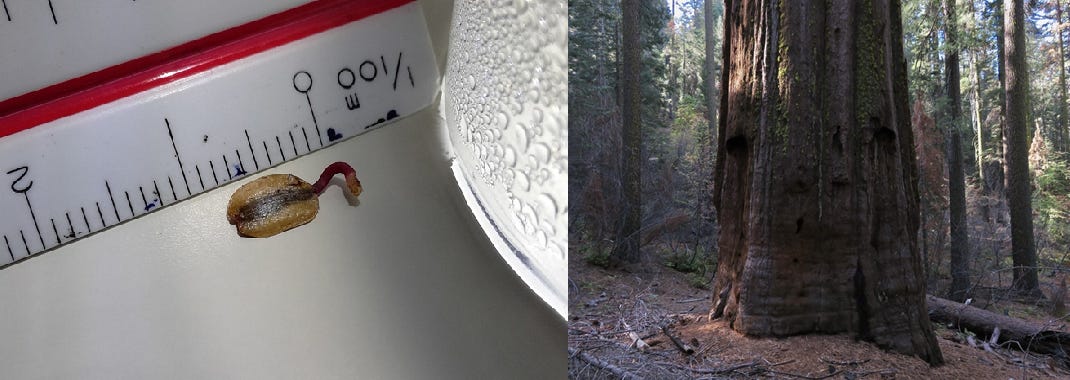
This giant sequoia (Sequoiadendron giganteum) is one of nature’s largest, longest crescendos. They live thousands of years and routinely grow more than 250 feet high and 90 feet in circumference.
And they start from a seed that’s about the same size as the sprinkles you top your ice cream with.

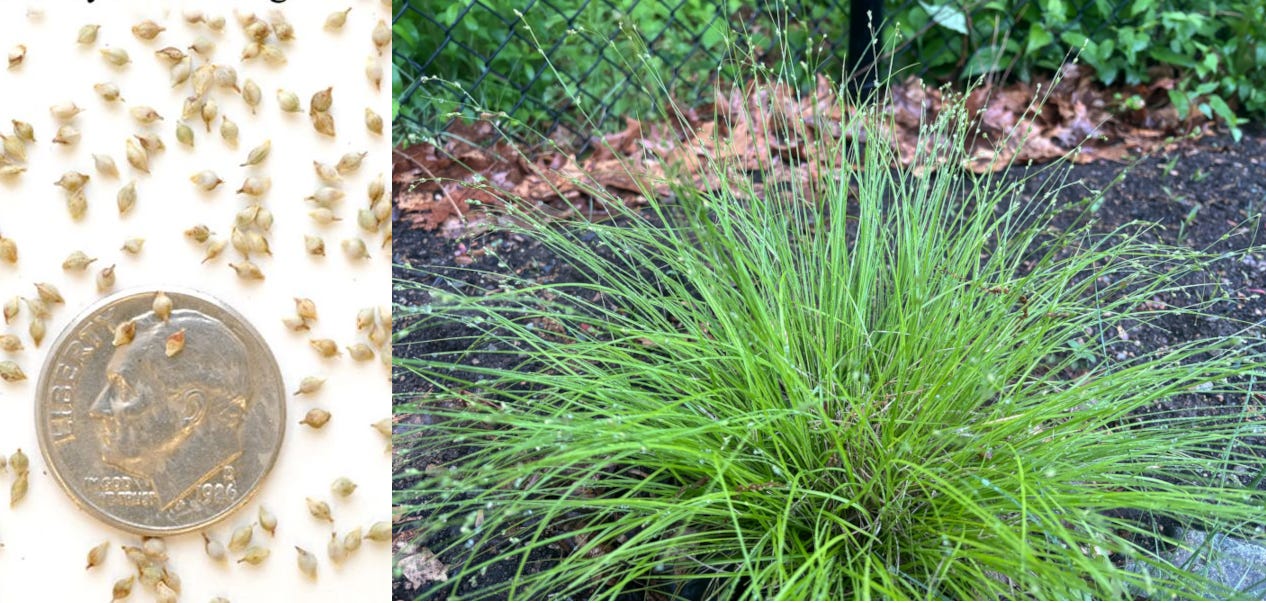
Seeds germinate all the time, in places you put them and places you didn’t. It’s therefore easy to overlook these little botanical starter kits. And honestly, while giant sequoias are magical, so’s the much more diminutive Pennsylvania Sedge, which blooms like a firework that’s afraid to make noise. A seed made that—or at least made it possible.
Let’s take back the “seed funding” metaphor from the business folks for a minute. You, the gardener, are an investor. You want your seed to become a seedling. And then eventually to have enough resources to start manufacturing cucumbers or flowers or whatever. But you’re not in there doing the day-to-day tasks of absorbing sunlight, converting it to chemical energy, taking up nutrients, and so on. You’ll just be having regular chats with senior leadership, making sure they have what they need.
And the first thing they need, long before they set down literal roots, is less (chemical) red tape.
The right conditions
Summer vegetable and herb seeds require very little work to get started because we’ve spent so much time breeding them that way. Biologists even have a name for this: easy, quick germination is part of a suite of characteristics associated with “domestication syndrome.” That is, people have selected for them so that they could more easily grow food.
The peppers, cucumbers, zinnias, cosmos, and melons you want to grow in the summer will germinate if you follow the instructions on their seed packs. To take this a step further, you could learn a little about where they’re from, and what conditions they’ve adapted to.
Peppers, for example, are probably from tropical parts of Peru, Ecuador, and Colombia. This is why pepper seed packs tell you they germinate best when the soil’s warmer (around 80°F, 26°C). Most people don’t have any 80°F soil lying around when it’s pepper-starting time. You can fake it though with a heating mat or a little greenhouse cover on your seed starting tray.
Seeds that haven’t been “domesticated” have dormancy mechanisms
If people haven’t spent thousands (and thousands) of years domesticating a plant, then its seeds probably still have dormancy mechanisms. These keep them “asleep” until the right moment, or as a biologist might put it, in “synchronization with the environment.”1
For example, species that are native to cold places, such as black-eyed Susans2, anise hyssop, and coreopsis, have a hard seed coat that prevents water from getting in and starting the seed’s engines at the wrong time. Imagine you are a seed from a cold place. You don’t want to germinate on a warm October day and then get hit by winter’s long, cold truck. To keep from doing this, you have a hard seed coat that “melts away” over months of cold and wet, i.e. winter.
In addition to the physical barrier, winter-dormant seeds have a chemical layer of protection. Winter reduces hormones that prevent growth (such as abscisic acid) and increasing ones that encourage it (such as gibberellic acid). This allows plants to germinate when it warms up in the spring.
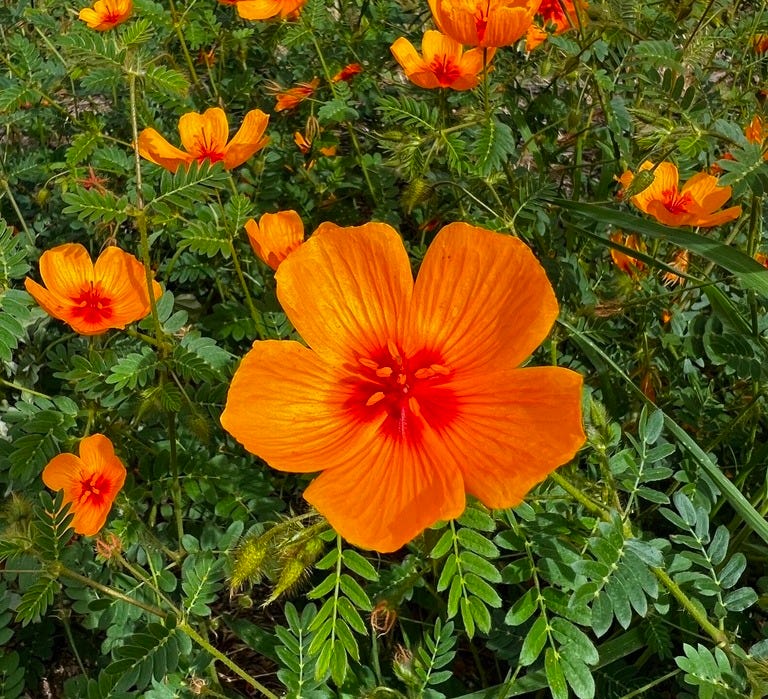
Winter isn’t the only condition that’s dangerous for plants. Death Valley, California, gets about 2 inches of rain per year. (We got that here in New England last week.) So species like summer poppy (Kallstroemia grandiflora) and devil’s claw (Proboscidea parviflora) have a sort of “checklist” for when it’s ok to grow. They need an inch or so in autumn, and then another inch through March.
Other species, like wild lilacs (Ceoanthus species) use fire as an indicator. This clever mechanism allows them to grow when there’s not as much competition, and when they’re less likely to be shaded out. They can sit in the soil for more than 200 years waiting for the right time.
The native-seed-starting gardener needs to learn some new vocabulary
Breaking dormancy is probably one of the barriers for people interested in starting native plants from seed. In theory, you could hurl them into your garden and ask your preferred deity to take the wheel. But most gardeners want to feel more confident about planting.
Fortunately, native plant people have some tricks. For example, you can use the milk jug method for seeds that need cold and wet (stratification), a method invented by American gardener Trudi Davidoff in collaboration with the U.S. Department of Agriculture. Davidoff supposedly said, “If it’s not easy, you’re doing it wrong.”
Imbibition
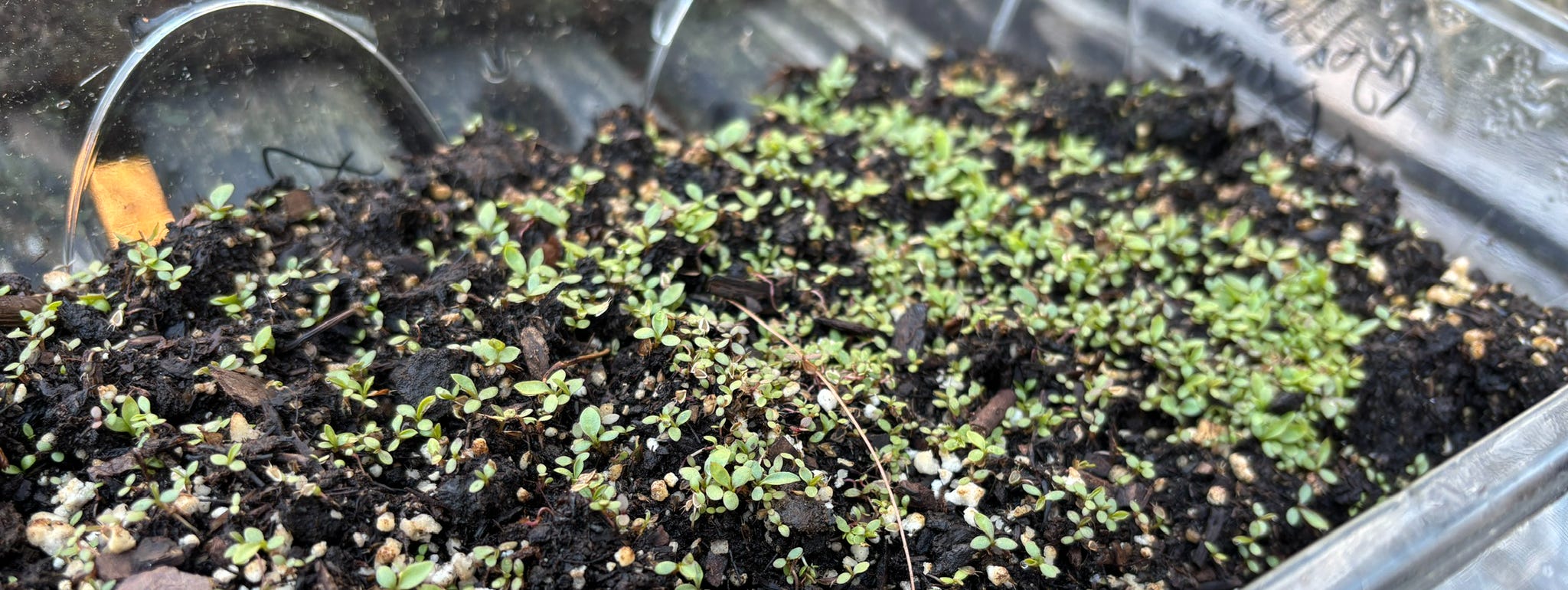
Once dormancy “breaks” and conditions are right (warm enough, moist enough, etc.), the seed’s ready to grow. Next is imbibition. Imbibe means to drink, and that’s what the seed does—takes in water. Internal enzymes activate. Energy stored in chemical form releases.
The seed is not getting light or nutrients at this point. Just water and oxygen. Oddly, it may be “aware” that there’s light close by, since that’s a germination cue, but it doesn’t have any way to photosynthesize yet.
Finally, the seed root, or radicle, emerges.3 It takes in water and nutrients from the soil or whatever medium you’re growing it in. This is a delicate time. If the radicle rots, the seedling will die. This is called damping off and is a big reason that when you start seeds indoors, you should use a mix designed to have plenty of drainage.
The seed stem (hypocotyl) pushes up next. This is often the first thing the attentive gardener notices. Once the seed stem breaks the soil surface, it turns green. In many species, it’s bent over like a hook shape to protect the delicate tip. As it comes up, friction with the soil usually helps pull the seed cap away, though sometimes you’ll see it get stuck on top of the stem. You can gently brush it away if it doesn’t fall off on its own.
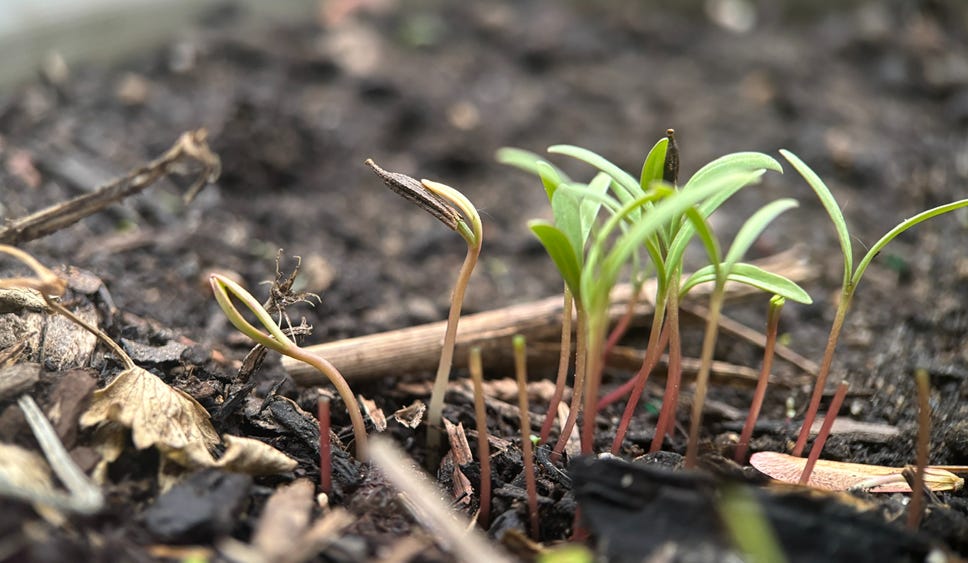
As an aside: This is a reason it’s important not to plant your seeds too deep. It takes precious energy to push up to the surface. A paper published by the USDA’s research division dryly reports that deeply-planted seeds might germinate, but “seed reserves may be exhausted before the seedling reaches the soil surface, which leads to seedling death.”
Finally, plants unfurl their cotyledons, or seed leaves.
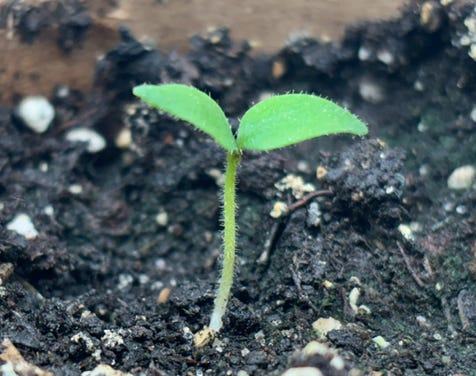
Cotyledons are packed with nutrients from when the seed was formed. Seedlings can break these nutrients down and use them. Some species have two (dicots), and others have just one (monocots). Some keep them underground, where they provide nutrients, and others above ground, where they start photosynthesizing.
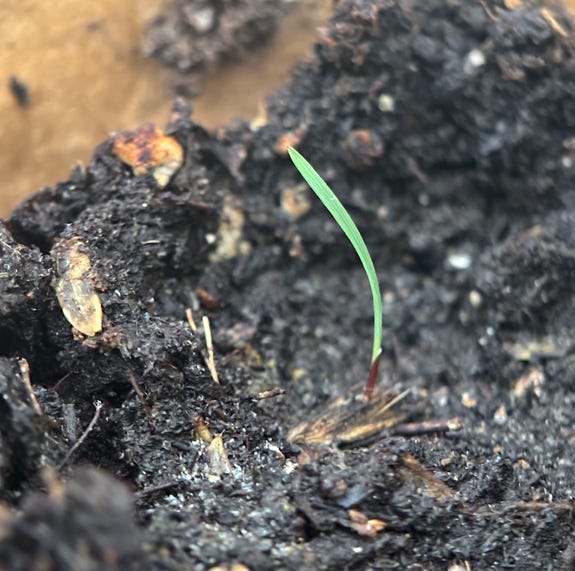
Most seeds’ supplies will be running a little low after accomplishing all this. They’ll have to begin gathering what they need from their environment.
How does the seedling know which direction is “down”?
Plants have a very cool way of knowing which direction to grow. Plant cells have little components called statoliths. These are heavy and settle on the bottom of the cell. Plants are able to use the location of these statoliths to “figure out” which way is down. Essentially, they can sense gravity.
This is why no matter which direction you plant a seed in, the radicle will grow down, even if it has to curve.
Plants can also sense light and move toward it. But this phototropism is separate from the gravitropism that helps the root grow in the right direction.
Indiana University has a very cool video of corn seed radicles emerging and growing in the right direction, even though seeds are oriented in different directions.
The introduction to an open-access 2006 paper in New Phytologist provides a useful overview of dormancy, though most of the paper is about beans.
Various species in the Rudbeckia genus, such as R. fulgida, R. hirta, R. laciniata, etc.
Much of this section is based on Britannica’s article on germination.